Product demo · MaRisk AT 4.4.2
The compliance module at a glance.
Regulatory inventory, monitoring of changes and assignment of requirements to the business unit, shown in excerpts of the app. Evidence and monitoring for each assigned requirement, with changes logged.
This is what it looks like in the app.
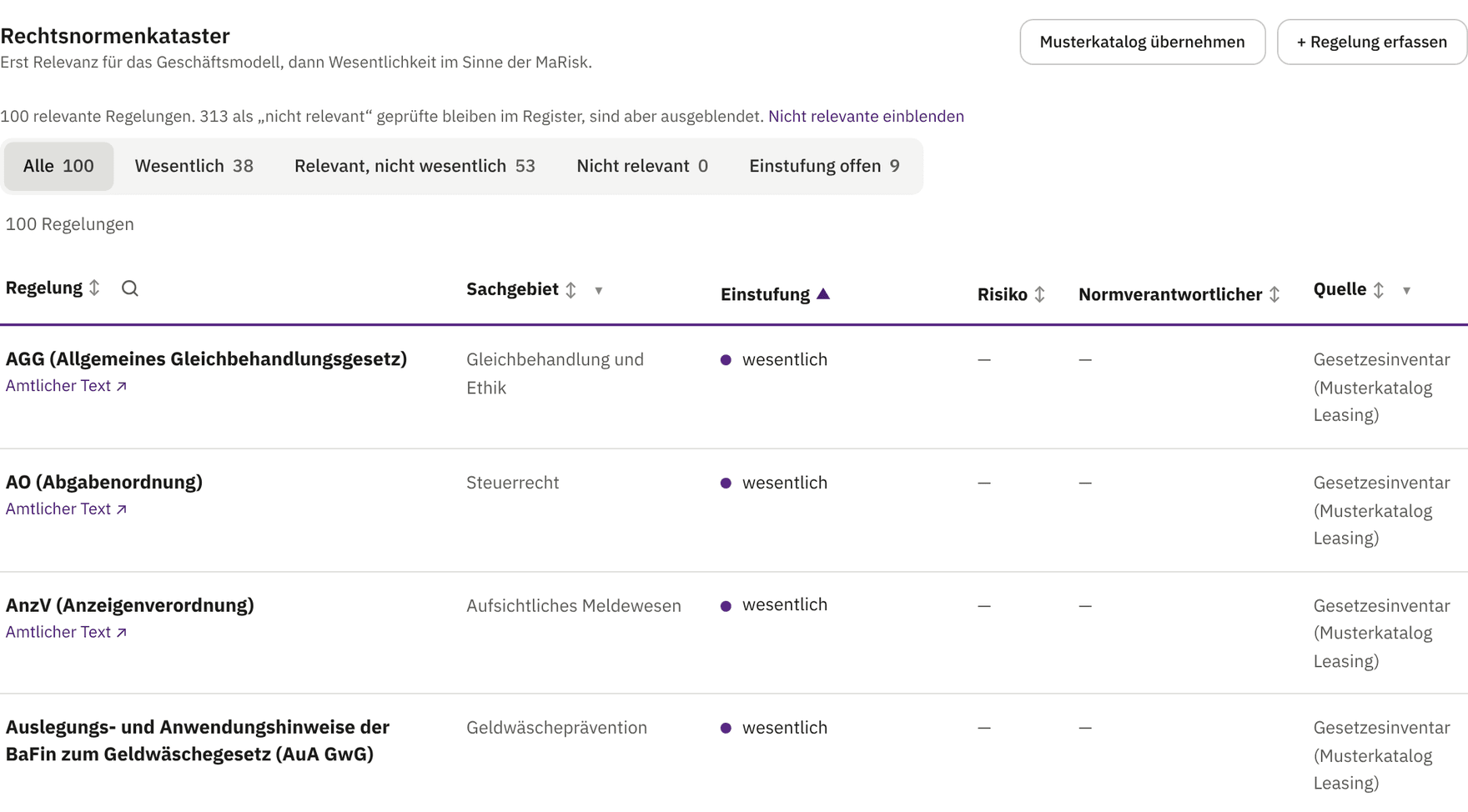
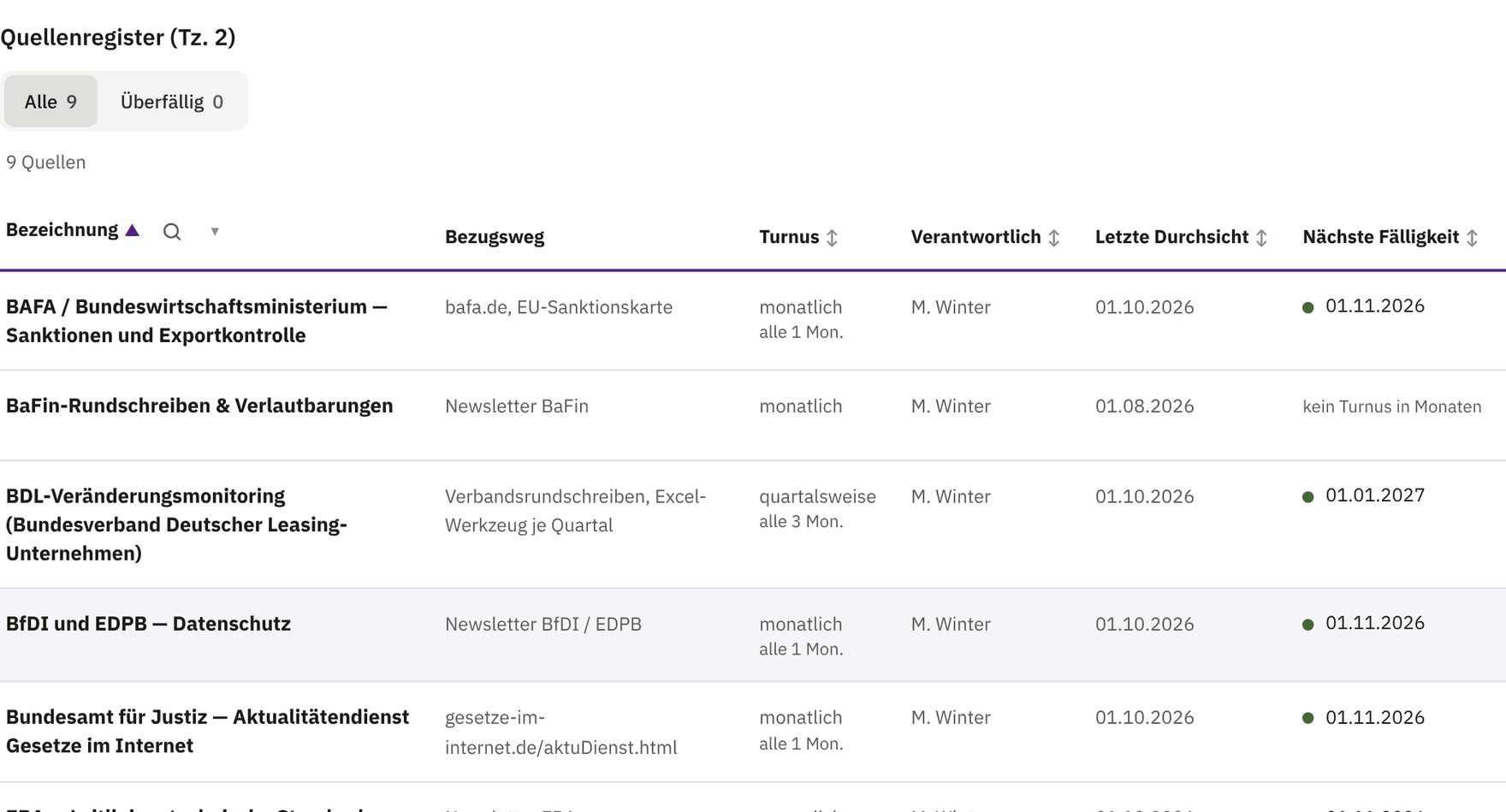
Regulatory inventory
Excerpt of the app’s model catalogue, as of 10/2026. Classifications are proposals for a leasing/factoring institution.
| Requirement | Subject area | Classification | Rationale |
|---|---|---|---|
| KWG (Kreditwesengesetz) | Bankaufsichtsrecht | material | Wesentlich nach AT 4.4.2 Tz. 2 MaRisk: Nichteinhaltung kann zu einer Gefährdung des Vermögens des Instituts führen. |
| MaRisk (Mindestanforderungen an das Risikomanagement) | Bankaufsichtsrecht | material | Wesentlich nach AT 4.4.2 Tz. 2 MaRisk: Nichteinhaltung kann zu einer Gefährdung des Vermögens des Instituts führen. |
| EBA-Leitlinien zu Auslagerungen (EBA/GL/2019/02) | Auslagerungsmanagement | material | Wesentlich nach AT 4.4.2 Tz. 2 MaRisk: Nichteinhaltung kann zu einer Gefährdung des Vermögens des Instituts führen. |
| Verordnung (EU) 2022/2554 (DORA) — digitale operationale Resilienz | IKT-Risikomanagement | material | Anwendbar seit 17.01.2025; IKT-Risikomanagement, IKT-Vorfälle, IKT-Drittparteienrisiko und Informationsregister (Art. 28 Abs. 3). |
| GwG (Geldwäschegesetz) | Geldwäscheprävention | material | Wesentlich nach AT 4.4.2 Tz. 2 MaRisk: Nichteinhaltung kann zu einer Gefährdung des Vermögens des Instituts führen. |
| DSGVO (Datenschutzgrundverordnung) | Datenschutz | material | Wesentlich nach AT 4.4.2 Tz. 2 MaRisk: Nichteinhaltung kann zu einer Gefährdung des Vermögens des Instituts führen. |
| HGB (Handelsgesetzbuch) | Rechnungslegung | material | Wesentlich nach AT 4.4.2 Tz. 2 MaRisk: Nichteinhaltung kann zu einer Gefährdung des Vermögens des Instituts führen. |
| Verordnung (EU) 2024/1689 (KI-Verordnung / AI Act) | Künstliche Intelligenz | classification open | Gestaffelt anwendbar; ob und wie das Institut betroffen ist, hängt vom Geschäftsmodell ab und ist in der eigenen Risikoanalyse zu klären. |
How norm screening works
- 01Starter catalogue instead of an empty register
A statute-level model catalogue for leasing and factoring institutions (§ 1(1a) sentence 2 nos. 9/10 KWG) can be adopted with one click.
- 02Classification as a proposal
Relevance and materiality are proposals. The institution confirms or changes them in its own compliance risk analysis (AT 4.4.2 para. 2 MaRisk) and remains responsible for them.
- 03New rules start as open
Where applicability depends on the business model, the requirement is shown as “classification open” rather than rated prematurely.
- 04Ongoing monitoring of changes
Observed sources with a fixed cycle, such as EBA, FATF, EDPB, ESMA and the update service of Gesetze im Internet. Changes are recorded, assessed and linked to a requirement.
The model catalogue is a starting aid, not legal advice and not a complete legal overview. The institution remains responsible for completeness and classification.
From the requirement to the business unit
- 01Assignment to the business unit
The compliance function proposes a responsible person in the business unit for the requirement.
- 02Confirmed, disputed or classified differently
The business unit confirms, and the date is shown in the register. Or it disputes with a reason. Or it proposes that the requirement does not apply to it or is not material.
- 03Decision with a reason
A dispute goes to the management board. The compliance function decides on a classification proposal; only it changes the classification, and the reason stays in the log.
- 04Measures through to effectiveness
Findings recorded for the requirement are reported as done by the business unit; Compliance confirms effectiveness.
Assignment with confirmation
Responsibilities for requirements are proposed, confirmed by the business unit or objected to with reasons, and decided in case of dissent. The sequence is logged.
Findings through to effectiveness review
A finding is only closed once Compliance has confirmed the effectiveness of the reported measure. Accepted risks receive a review date.
Annual report with version chain
Final reports are never overwritten. A correction is a new version with a stated reason; acknowledgement by the management board and forwarding to internal audit apply per version.
Auditor access, read-only and logged
Auditors receive narrowly scoped read access to approved data. Every access is logged; permissions are checked server-side on every request.
Would you like to see your own requirements in RegStack?
In 30 minutes we show you the compliance module with your own requirements, including findings, annual report and auditor access.